
Who this guide is for
This guide is for Texas homeowners who may use insurance to pay for part of a roof. It explains who does what, in plain words.
It is educational. It is not legal advice or insurance advice. Your policy and your insurer have the final word on your claim.
We wrote it because the roles get blurred after a storm. Some contractors promise things the law does not let them do. Knowing the rules protects you.
The three roles
A roof claim in Texas has three parties. Each has one job.
- You, the homeowner. You file the claim. You choose your contractor. You pay your deductible.
- Your insurer. Your insurer decides coverage and the amount. Its adjuster inspects the roof for the insurer.
- Your roofer. We document the damage, write an estimate and build the roof.
A roofing contractor in Texas may not act as a public adjuster on a roof it works on. A contractor also may not advertise that it does. The Texas Department of Insurance says a website counts as advertising.
So we do not file claims, and we do not speak for you with your insurer. We do the technical work, and we put it in writing.
How the process works, step by step
- Get the roof documented. Book a free photo inspection. We inspect and document storm damage with photos and measurements.
- Review the photos. We walk you through what we found. Sometimes the photos show no storm damage, and we tell you that.
- Read your policy. Look at the declarations page. Find your wind and hail deductible and note how the policy treats your roof.
- You decide whether to file. The Texas Department of Insurance advises filing as soon as you can after hail or wind. You file the claim with your insurer.
- We give you a written estimate. We give you a written, itemized estimate you can share with your insurer.
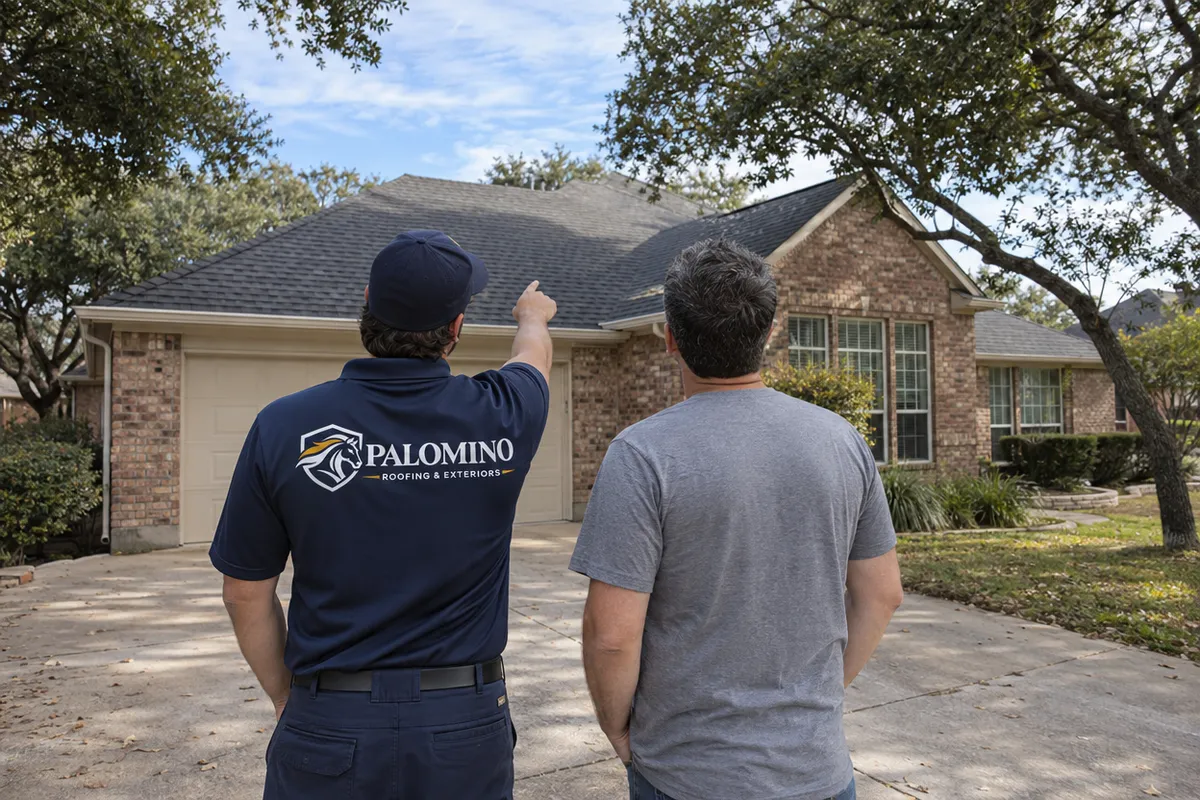
- The adjuster inspects. Your insurer sends its adjuster. We can meet your insurance adjuster on the roof to point out the damage we found and review our estimate and technical details.
- Your insurer decides. Your insurer decides coverage and the amount. That decision belongs to the insurer alone.
- You sign a written contract. The work follows your insurer's approved scope. Read every page, and never sign a contract with blank spaces.
- We build the roof. No payment is due until materials are delivered and work begins. You get dated photos of each stage.
- You pay your deductible and keep the receipt. We give you an invoice and receipt showing it was paid.
What a roofer may and may not do
The Texas Department of Insurance says contractors may provide estimates. They may also discuss those estimates and other technical information with an insurer or its adjuster.
That is the full list of what we do with your insurer. Here is how it looks in practice.
What we do:
- Inspect the roof and photograph every slope.
- Measure and document storm damage.
- Write an itemized estimate for the repair or replacement.
- Meet the adjuster on the roof to review technical details.
- Build the roof and photograph each stage.
What we do not do:
- Submit the claim. That step is yours.
- Act as your representative with the insurer.
- Decide or argue what your policy pays.
- Ask you to sign over your claim or give us power of attorney.
If a contractor offers any item on the second list, be careful. Those jobs belong to you or to a public adjuster, not to a roofer.
Your deductible and Texas law
This is the rule homeowners hear the most confusion about. So here it is plainly.
Texas law requires you to pay your deductible. We give you an invoice and receipt showing it was paid.
Under Texas law, a contractor may not pay, waive, absorb or rebate an insurance deductible. Texas law also bars a contractor from advertising or promising to do so. The statute is Business and Commerce Code section 27.02.
The Texas Department of Insurance says rebates or credits in the amount of the deductible are illegal too. That is why we offer no gift cards or credits on an insurance-funded roof.
The penalty
Offering to waive a deductible is a Class B misdemeanor under Texas law. The Texas Department of Insurance describes the penalty as up to a $2,000 fine and up to six months in jail.
The contract notice
Texas law requires a written deductible notice in some roofing contracts. It applies to contracts of $1,000 or more that are expected to be paid from a property claim. Look for that notice before you sign.
Proof that you paid
Your insurance company can ask for proof that you paid your deductible. The Texas Department of Insurance lists what counts:
- A canceled check
- A money order receipt
- A credit card statement
- A copy of a payment plan
We give you an invoice and a receipt for your records. Keep them with your claim papers.
This proof can affect your payout. Under Insurance Code section 707.004, an insurer may hold back part of your payment until it gets proof the deductible was paid.
The 2% wind and hail deductible
Many North Texas policies now carry a 2% wind and hail deductible. The percentage is figured on your home, not on the cost of the roof.
That adds up fast. A 2% deductible is $8,000 on a $400,000 home. Check your own policy's declarations page for your number.
Roof age matters as well. Roofs about 15 to 20 years old may be limited to actual cash value, according to United Policyholders. Ask your agent how your policy treats your roof before a storm, not after.
For many homeowners, this means paying a large part of a new roof themselves. A clear, written price helps you plan. Our roof replacement cost guide shows published DFW ranges.
Your three-day right to cancel
If you sign a contract at your home, Texas law lets you cancel until midnight of the third business day. Your contract must include the cancellation form.
This right exists to protect you from pressure at the door. Use the time to read the contract and compare bids. A contractor who rushes you past it is a warning sign.
Payment timing on storm work
Texas has a law on disaster repair contracts, in Business and Commerce Code chapter 58. In a declared disaster, it limits when some contractors may take payment.
Our policy is simple, and it applies to every storm job. No payment is due until materials are delivered and work begins.
Materials and options on an insurance-funded roof
Insurance-funded work follows your insurer's approved scope and your deductible. The approved scope lists the materials and work your insurer has agreed to pay for.
You may want something beyond that scope. A common example is a move to Class 4 impact-resistant shingles. Ask us for a written line-item price, so you can see the difference.
A Class 4 roof can lower your homeowners insurance. Each insurer sets its own discount and paperwork. Read more on our impact-resistant Class 4 shingles page.
The proof you get from us
Our part of a claim is documentation and construction. Both come with proof you can hold.
- Photo inspection reportEvery inspection ends with a photo report you keep. Good and bad.
- Written line-item quotesEvery material and labor line in writing. No lump sums.
- Install photosDated photos of tear-off, decking, underlayment, flashing and cleanup.
- Local and owner-ledVictor owns the company and answers for every job.
- General liability insuranceCertificate on request.
See a sample inspection report and a sample line-item quote.
How to protect yourself after a storm
The Texas Department of Insurance gives homeowners this advice after hail or windstorms:
- Get more than one bid.
- Check references and Better Business Bureau complaints.
- Never sign a contract with blank spaces.
- Do not pay in full up front.
Texas does not license roofing contractors at the state level. That makes written proof and local accountability more important. Ask for photos, a line-item estimate and a written warranty.
The Texas Department of Insurance directs reports of violations to the Texas Attorney General. You can reach that office at 800-621-0508.
Related pages
- Hail and storm damage: what a storm inspection includes.
- Roof inspection: the free photo report.
- Roof replacement: how we build the roof.
- Sample inspection report: see the report format.
- FAQ: short answers to common questions.
Ready for photos of your roof? Book a free inspection.