
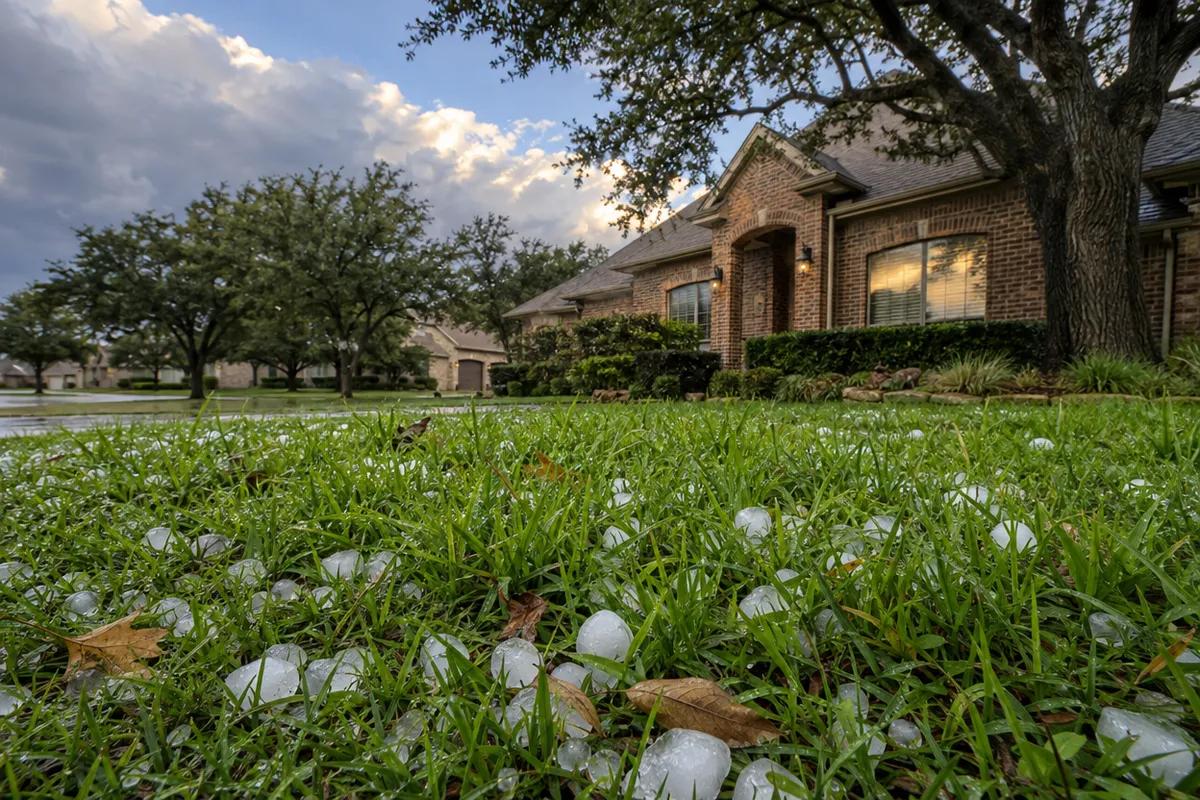
First, slow down
Hail is loud and fast. The decisions after it do not have to be. Nothing on this list needs to happen in the first hour, and no one at your door should tell you otherwise.
Here is a calm order of operations for the days after a storm.
Step 1: Document what you can see from the ground
Stay off the roof. Walk the yard and take dated photos of anything the hail marked:
- Dented gutters, downspouts and window screens
- Damaged fence boards
- Shingle pieces or granules on the ground
- Water stains on ceilings inside
Write down the date and rough time of the storm. You will be asked for it more than once.
Step 2: Get the roof inspected and photographed
You cannot see most of a roof from the driveway. A proper inspection covers every slope, plus flashing, vents, pipe boots and ridge caps.
Ask for the photos. A roofer who found damage should be able to show it to you. Our roof inspection ends with a photo report you keep, whether or not you hire us. You can see the format in our sample inspection report.
Sometimes the report shows no damage. That is a good result, and it is worth having in writing.
Step 3: Follow the state's advice
The Texas Department of Insurance, known as TDI, publishes advice for homeowners after hail or windstorms. In short, TDI advises you to:
- File a claim as soon as you can.
- Get more than one bid.
- Check references and BBB complaints.
- Never sign a contract with blank spaces.
- Not pay in full up front.
Every item on that list protects you. None of them requires you to sign anything on the day of the storm.
Step 4: Know who does what in a claim
This part confuses many people, and Texas law is strict about it. There are three roles.
| Who | What they do |
|---|---|
| You | You file the claim with your insurer. |
| Your insurer | Decides coverage and the amount. |
| Your roofer | Documents the damage, writes an estimate and builds the roof. |
In our words: You file the claim. Your insurer decides coverage and the amount. We build the roof.
A roofer can still be useful during the claim. We inspect and document storm damage with photos and measurements. We give you a written, itemized estimate you can share with your insurer.
We can meet your insurance adjuster on the roof to point out the damage we found and review our estimate and technical details. That is where a roofer's part ends. A contractor may not act as your adjuster on a roof it is working on.
Our insurance claims page walks through each stage.
Step 5: Understand your deductible before you sign
Many North Texas policies now carry a 2% wind and hail deductible. As an example, that is $8,000 on a $400,000 home. Your own figure is on your policy's declarations page.
Texas law requires you to pay your deductible. We give you an invoice and receipt showing it was paid.
The law on this is plain. TDI says it is illegal for a contractor to waive your deductible or help you avoid paying it. Under Texas law, a rebate or credit in the amount of the deductible is illegal too.
It is a Class B misdemeanor. TDI describes the penalty as up to a $2,000 fine and up to six months in jail.
Your insurer can also ask for proof that you paid. A canceled check, a money order receipt, a credit card statement or a copy of a payment plan counts.
Step 6: Know your rights on the contract
Two Texas rules are worth knowing before anyone hands you a pen.
You can cancel within three business days
If you sign a contract at your home, Texas law lets you cancel until midnight of the third business day. The contract must include the cancellation form. A contract signed at your kitchen table is not final that night.
Payment should not come first
Our rule is simple, and we put it in writing. No payment is due until materials are delivered and work begins.
Texas has a specific law for repair work after a declared disaster. It bars many contractors from taking payment before work begins. Any roofer who asks for full payment before a shingle is delivered is asking you to carry all the risk.
How to spot storm-chaser pressure
After a big hail day, a lot of people knock on doors. Some are good local roofers. Some are not. You do not need to know which company is which. You only need to notice the behavior.
Be careful when someone:
- Wants a signature today. A real offer is still there after you get a second bid.
- Says you will pay nothing. Your insurance company decides coverage, and Texas law requires you to pay your deductible.
- Offers to speak for you with your insurer. That is not a roofer's role in Texas.
- Hands you a form with blank spaces. TDI says never to sign one.
- Asks for full payment up front. TDI advises against it.
- Cannot show photos. Damage that is real can be photographed.
- Claims a state roofing license. Texas does not license roofing contractors at the state level.
- Has no written, itemized estimate. A single lump sum tells you nothing.
If a pitch fails two or three of these, thank the person and close the door. You lose nothing by waiting a day.
When does hail season hit DFW?
Spring. We tallied National Weather Service preliminary reports of hail 1 inch or larger across five DFW counties. The data runs from 2015 through September 2026 and covers 1,292 reports.
- March through June produced 88.6% of them.
- April alone produced 30.5%.
- Tarrant County had the most reports, at 457, and led every year from 2023 through 2026.
- The largest single day was May 28, 2024, with 65 reports around Arlington and northeast Tarrant County.
Hail still falls outside spring. September accounts for 4.4% of reports. These counts measure reported hail, not damage to any one home.
What this looks like with us
Palomino Roofing & Exteriors is a new, owner-led company. Victor leads the work. We built our process around showing you the evidence.
- A photo report after every inspection
- A written quote with every material and labor line
- Dated photos of tear-off, decking, underlayment, flashing and final cleanup
If we recommend an item, we show you the photo. If we cannot show photo evidence for it, that line comes off the quote.
Read more about hail and storm damage work, or book an inspection when you are ready. There is no rush from our side.